Critical minerals, lithium and the new space economy: a strategic agenda for Argentine development
Argentina Space highlights the “Beyond Lithium” conversation, organised by Universidad Austral, as part of a key discussion for the country's productive, technological and geopolitical future.
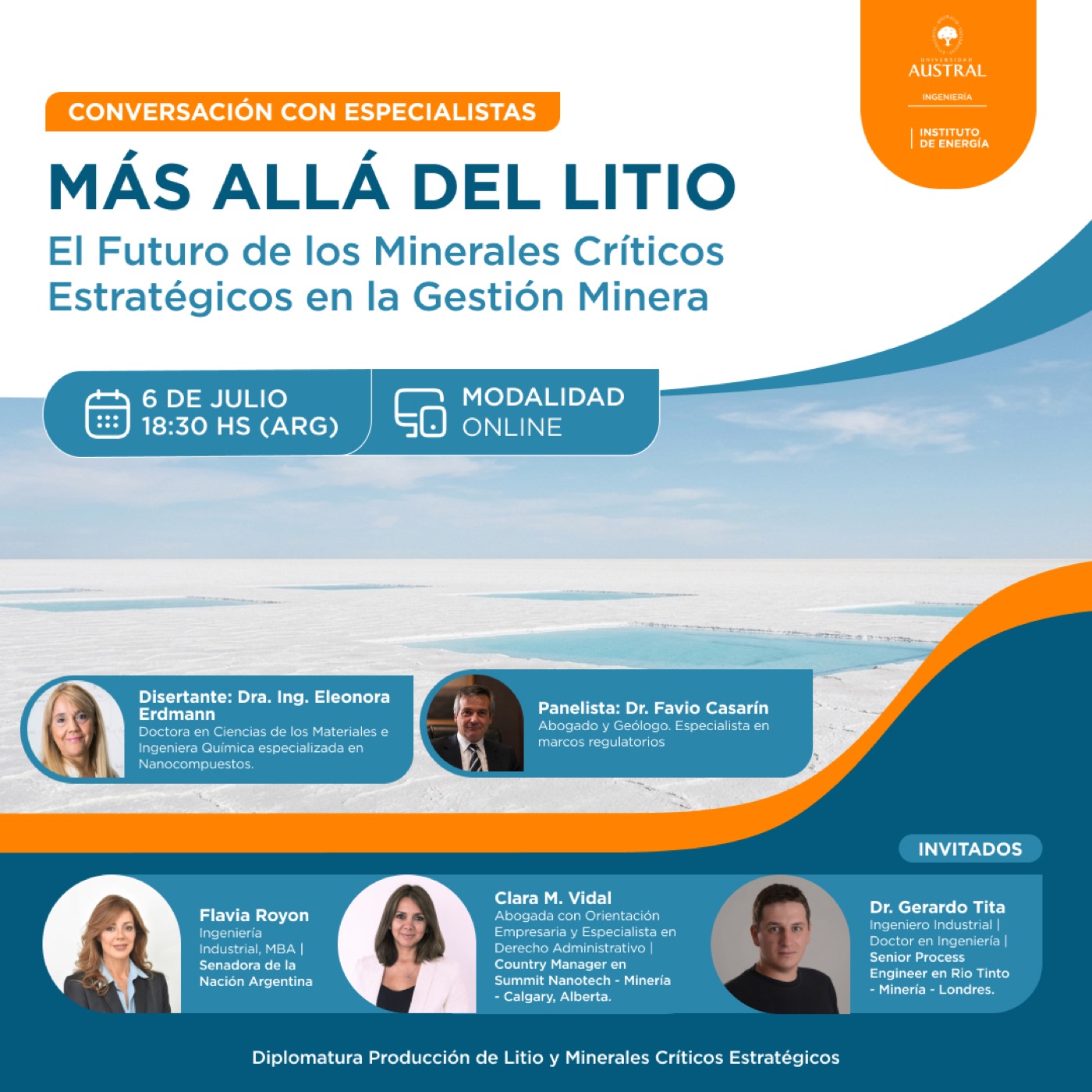
Universidad Austral will hold on Monday, July 6, at 18:30 the specialist conversation “Beyond Lithium: the future of Strategic Critical Minerals in Mining Management”, an online event within the framework of the 2026 Diploma in Lithium and Strategic Critical Minerals Production.
The session will bring together figures from the academic, professional, legal, productive and business sectors to analyse the new paradigm of global mining, shaped by the energy transition, the demand for new technologies, regulatory challenges and the need to train professionals capable of managing strategic projects in increasingly complex scenarios.
At Argentina Space, an initiative aimed at driving the development of the new space economy in the country, the debate on critical minerals holds a central place. Lithium, copper, nickel, cobalt, graphite, silicon, rare earths and other strategic resources can no longer be thought of solely through an extractive lens. They are essential inputs for batteries, sensors, semiconductors, communication systems, energy infrastructure, advanced electronics, electric mobility, defence, satellites and technologies tied to the aerospace sector.
Argentina holds strategic resources that, in the current global scenario, can no longer be analysed simply as raw materials. Their real value lies in the capacity to integrate them into chains of knowledge, technological development, industrial production, investment and institutional coordination.
In that framework, critical minerals are part of a broader agenda connecting mining, the energy transition, innovation, defence, communications, satellite infrastructure and the new space economy. For countries like Argentina, the challenge is not limited to holding these resources, but to building the capabilities needed to turn them into added value, skilled employment and international standing.
The Universidad Austral conversation proposes going beyond a view focused exclusively on lithium, widening the analysis to the whole set of strategic critical minerals now redefining the world economy. The session will address the opportunities and tensions running through the sector: new production methods, regulatory frameworks, project management, professional leadership and trends in an expanding global market.
Speakers and panellists will include Dr. Eng. Eleonora Erdmann, PhD in Materials Science, chemical engineer specialising in nanocomposites and director of the Diploma; Dr. Favio Casarín, lawyer, geologist and specialist in regulatory frameworks; Clara M. Vidal, lawyer specialising in administrative law and currently Country Manager at Summit Nanotech; Flavia Royon, industrial engineer, MBA and national senator; and Dr. Gerardo Tita, industrial engineer, PhD in Engineering and Senior Process Engineer at Rio Tinto in London.
The critical minerals agenda and the space agenda converge on a single point: the need to build our own capabilities to take part in the industries that will define the coming decades. In a world where technology, energy, security and orbital infrastructure depend increasingly on strategic materials, Argentina must discuss not only which resources it holds, but what place it wants to occupy in global value chains.
Argentina Space supports and values this kind of training and debate, convinced that the country's future is played out in the coordination between knowledge, the public sector, companies, universities, investment and strategic vision.
The session will be online, open with prior registration, and will take place on Monday, July 6 at 18:30.
Registration:
https://www.austral.edu.ar/ingenieria/ingenieria-posgrados/energia/dplt-webjul/?utm_source=Directoresdeenerg%C3%ADa